

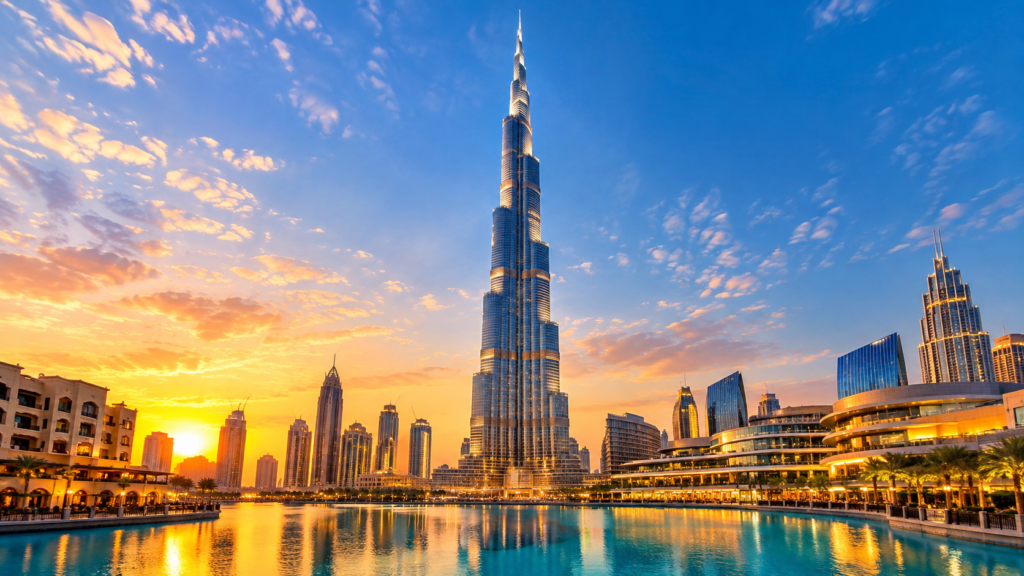
Seeing Burj Khalifa for the First Time
A Moment That Makes Dubai Feel Real
There are some places you recognise long before you ever visit them. You have seen their photographs, watched them appear in films and travel videos, and heard people describe them so many times that they almost feel familiar.
The Burj Khalifa is one of those places.
For years, it has stood as one of Dubai’s most recognisable landmarks, rising above the city in photographs that make the surrounding buildings look surprisingly small. You may think you already know what it looks like before you arrive. Yet seeing it in person is a different experience altogether.
A photograph can show you its height. It cannot quite prepare you for the feeling of standing at its base, looking upwards and trying to take in the entire structure.
And that is where the experience begins.
The First Glimpse: When the Skyline Changes
Dubai has a way of revealing itself gradually as you travel through the city. Roads stretch between modern buildings, glass towers catch the sunlight, and new developments seem to appear around every turn.
Then, almost without warning, the Burj Khalifa begins to dominate the skyline.
At first, you may notice only its extraordinary height above the surrounding buildings. As you get closer, the structure becomes more defined, its elegant shape narrowing towards the sky. What looked like a distant feature of the city becomes something enormous and unmistakably real.
You find yourself looking up.
Then looking up a little further.
The building seems to rise beyond the scale your eyes naturally expect. Even when you know the figures, the experience is difficult to understand until you stand beneath it.
The Burj Khalifa reaches 828 metres into the sky and has 163 floors above ground. It opened in January 2010 and remains the world’s tallest building as of 2026.
Those facts are impressive, but numbers are only part of the story. The real impact comes from the contrast between the human scale of the people around you and the immense structure rising above them.
For a moment, you may forget about your camera, your plans and the next attraction on your itinerary. You simply stand there, taking it in.
Standing Beneath a Giant
The area around the Burj Khalifa is busy with visitors, families, photographers and people moving between nearby attractions. Some arrive knowing exactly where they want to take their photographs. Others stop unexpectedly when the tower comes into view.
Look around and you will notice how differently people react.
Some immediately reach for their phones. Children point towards the top. Couples try to capture a photograph with the entire building behind them. Others stand quietly, studying the architecture.
It is one of those travel moments when everyone seems to be looking in the same direction, even though each person may be experiencing something different.
If you are travelling with children, this can be a particularly memorable introduction to Dubai. Famous landmarks sometimes feel distant to young travellers until they can see them with their own eyes. Suddenly, a building they have heard about becomes something they can talk about, photograph and remember.
You do not need to rush straight towards the entrance or book an activity immediately. Give yourself time to experience the surroundings.
Walk a little, look for a comfortable place to stop and observe the tower from different angles. The view changes as you move, and the building can appear dramatically different depending on your position.
Sometimes the simplest part of the visit — standing outside and looking up — becomes the moment you remember most clearly.
Understanding the Building Beyond Its Height
The Burj Khalifa is more than a very tall building. It represents Dubai’s ambition to create a global destination known for architecture, tourism and modern development.
Its design was inspired in part by the geometry of the Hymenocallis flower, and its stepped form helps create its distinctive silhouette. The tower was developed by Emaar Properties and designed by architectural firm Skidmore, Owings & Merrill, with architect Adrian Smith leading the design.
From a distance, its shape looks sleek and almost delicate. Up close, the scale of the structure becomes more apparent.
The building contains residences, offices, the Armani Hotel, observation experiences and other facilities. It is not simply a viewing attraction built for tourists; it is part of a larger development that has helped define modern Downtown Dubai.
Knowing a little about its design and history can make the visit more meaningful. Instead of seeing it only as a famous landmark, you begin to appreciate the planning, engineering and ambition required to create a structure of this scale.
You may also find yourself thinking about how different Dubai looked before the tower became part of its skyline.
That contrast between the city’s earlier history and its modern identity is one of the most interesting things about exploring Dubai.
Going Higher: Seeing Dubai from Above
For many visitors, seeing the Burj Khalifa from the ground is only the beginning. The observation experiences offer an opportunity to look out across Dubai from much higher up.
The popular At the Top experience includes observation levels on the 124th and 125th floors. A separate premium experience, At the Top SKY, provides access to the 148th-floor observation level as part of its offering. Availability, access arrangements and ticket options can change, so check the official Burj Khalifa website before planning your visit.
The journey upwards adds another dimension to the experience. Once you reach the observation area, the city opens out beneath you.
Roads that seemed enormous from street level become fine lines across the landscape. Buildings form clusters, and the urban development stretches towards the coastline and surrounding desert. Depending on visibility, you may be able to see the contrast between Dubai’s dense modern districts and the flatter landscape beyond them.
From this height, the city can look almost unreal.
Yet what you are seeing is a working city — a place where people live, commute, work, study and raise families. The view is spectacular partly because it allows you to understand the scale of that everyday life from an entirely different perspective.
If this is your first visit, take your time at the windows. You do not have to move quickly from one photograph to the next. Watch the roads, observe the buildings and notice how the view changes as the light shifts.
For children, the observation deck can turn geography into a real experience. They can see how neighbourhoods connect, how far the city extends and why planning transport matters when visiting different attractions.
The experience is not essential for every traveller, particularly if you prefer to spend your budget on other activities. But if looking out across a vast modern city appeals to you, it can be one of the defining moments of a Dubai trip.
Dubai Mall: An Easy Addition to Your Visit
One of the practical advantages of visiting the Burj Khalifa is its location beside Dubai Mall.
This makes it relatively easy to combine two major attractions in one outing without spending unnecessary time travelling across the city. Dubai Mall offers shopping, dining, entertainment and indoor attractions, making it a useful destination for families as well as visitors travelling without children.
After spending time outside, especially during warmer weather, an air-conditioned indoor space can be a welcome break.
You can enjoy a meal, explore the mall or simply take a rest before continuing your day. The surrounding Downtown Dubai area also offers places to walk and view the tower from different perspectives.
If you plan to visit both the Burj Khalifa observation deck and Dubai Mall, allow enough time for each. Booking a timed observation ticket does not mean you need to fill every remaining minute with another activity.
A relaxed visit often feels better than trying to fit too much into a single day.
For a more detailed plan, see our guide to Burj Khalifa and Dubai Mall
The Best Time to Visit
The time you choose can influence how you experience the Burj Khalifa.
Morning can suit visitors who prefer to begin their sightseeing early and continue to other attractions afterwards. Visibility varies with weather and atmospheric conditions, so a morning visit does not guarantee the clearest view.
Late afternoon can offer a chance to see the city in daylight and watch the changing light as evening approaches. This period is popular, so check ticket availability well in advance.
After dark, the illuminated skyline gives Dubai a different character. Roads, buildings and the surrounding Downtown district create a striking cityscape, although the distant view may be less detailed than during clear daylight.
There is no universally perfect time. Consider your priorities, budget, travel dates and the needs of your group. If you are travelling with young children, a time that fits their energy levels may be more valuable than chasing a particular view.
Before booking, confirm the available time slots and current ticket conditions on the official website.
Visiting with Children: Make the Moment Their Own
A family visit to the Burj Khalifa does not have to revolve around photographs or reaching the highest possible observation level.
Children may be fascinated by the height of the tower, the fast lift journey, the view from above or simply the crowds gathering to look at the building. Their favourite part may not be the one adults expect.
Give them time to look around and ask questions. Explain how the building rises above the city, point out the roads and buildings from the observation area, or invite them to choose a favourite view.
If you are planning to go up the tower, check the ticket rules, arrival requirements and any restrictions that may affect your family. Keep some flexibility in your schedule, particularly if you are combining the visit with Dubai Mall.
It is also worth thinking about the practical details. Wear comfortable footwear, carry water when appropriate, and plan meal and rest breaks around your booked time.
Most importantly, avoid treating the visit as another item to tick off a list. The best family travel memories often come from having enough time to enjoy a place together.
Practical Tips Before You Go
A little preparation can make the experience smoother.
Book through official channels. Check current ticket prices, available observation levels, time slots and entry conditions directly with the Burj Khalifa’s official ticketing service.
Arrive with time to spare. Allow time to reach the correct entrance, navigate Dubai Mall and follow the ticket instructions. The route through a large complex can take longer than expected.
Check transport in advance. The Dubai Metro’s Burj Khalifa/Dubai Mall station serves the area, but walking connections and access routes can take time. Taxis may be more convenient for some families or when travelling with luggage.
Plan around the weather. Dubai can be extremely hot during parts of the year. Consider outdoor walking time, sun protection and opportunities to rest indoors.
Allow time for photographs. You may want pictures from the base of the tower as well as from the observation area. Take them, but leave room to enjoy the experience without viewing everything through a screen.
Keep the day flexible. If you are visiting Dubai Mall as well, you may find that you want to stay longer than expected. Avoid scheduling too many distant attractions immediately before or after your visit.
Is the Burj Khalifa Worth Visiting?
Whether the observation deck is worth the cost depends on what you enjoy when travelling.
If you love architecture, panoramic views and seeing a city from above, it can be a rewarding experience. If your main interest is local history, neighbourhoods or food, you may prefer to admire the tower from outside and use your budget elsewhere.
You do not need to purchase the most expensive ticket to appreciate the landmark. The exterior, the surrounding Downtown area and the view of the tower from nearby public spaces can all be memorable in their own right.
For a first-time visitor, the most important decision is to choose the experience that suits your interests rather than assuming that every famous attraction must be visited in the same way.
Travel is personal. The right choice is the one that adds meaning to your own journey.
A Landmark, and a Memory
When you think back on seeing the Burj Khalifa for the first time, you may remember its height, its distinctive shape or the view from above.
But you might also remember smaller details: the moment it appeared beyond the buildings, the feeling of standing beneath it, the children looking up, or the way the city seemed to stretch endlessly into the distance.
That is what makes a famous landmark more than a photograph.
The Burj Khalifa is an engineering achievement and a symbol of modern Dubai, but for a traveller, it is also a moment in a much larger story — a first encounter with a city, a shared family experience or a memory attached to a particular journey.
You may have seen it hundreds of times on a screen before you arrive. Seeing it in person gives those familiar images a new meaning.
And when you finally walk away, Dubai does not suddenly become less impressive. Instead, the skyline begins to feel more real. You have seen it from the ground, perhaps from above, and experienced a small part of the city for yourself.
Your Journey Starts Here.
Explore more with Dolphin Travelers: Discover our Dubai Travel Guide for family-friendly ideas, practical transport advice, desert experiences and ways to make the most of your time in the city.
Travel details, ticket options and opening arrangements can change. Check official sources before making important plans.